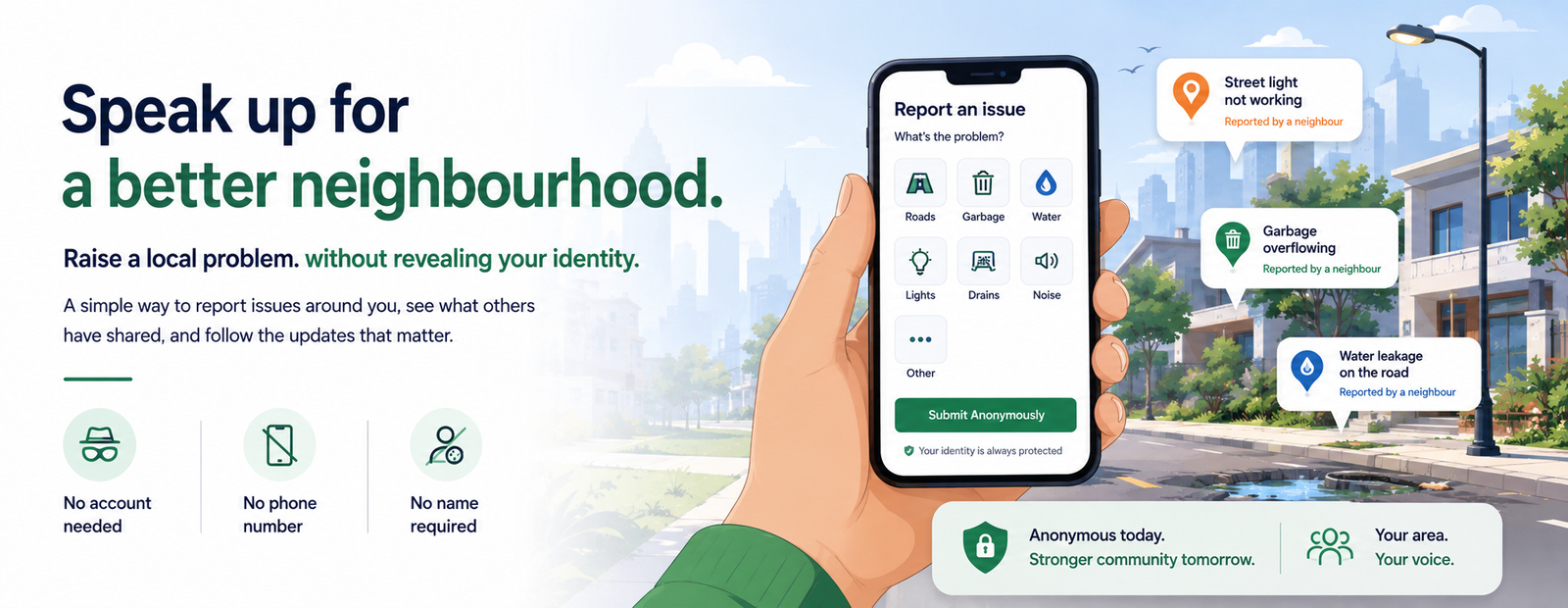
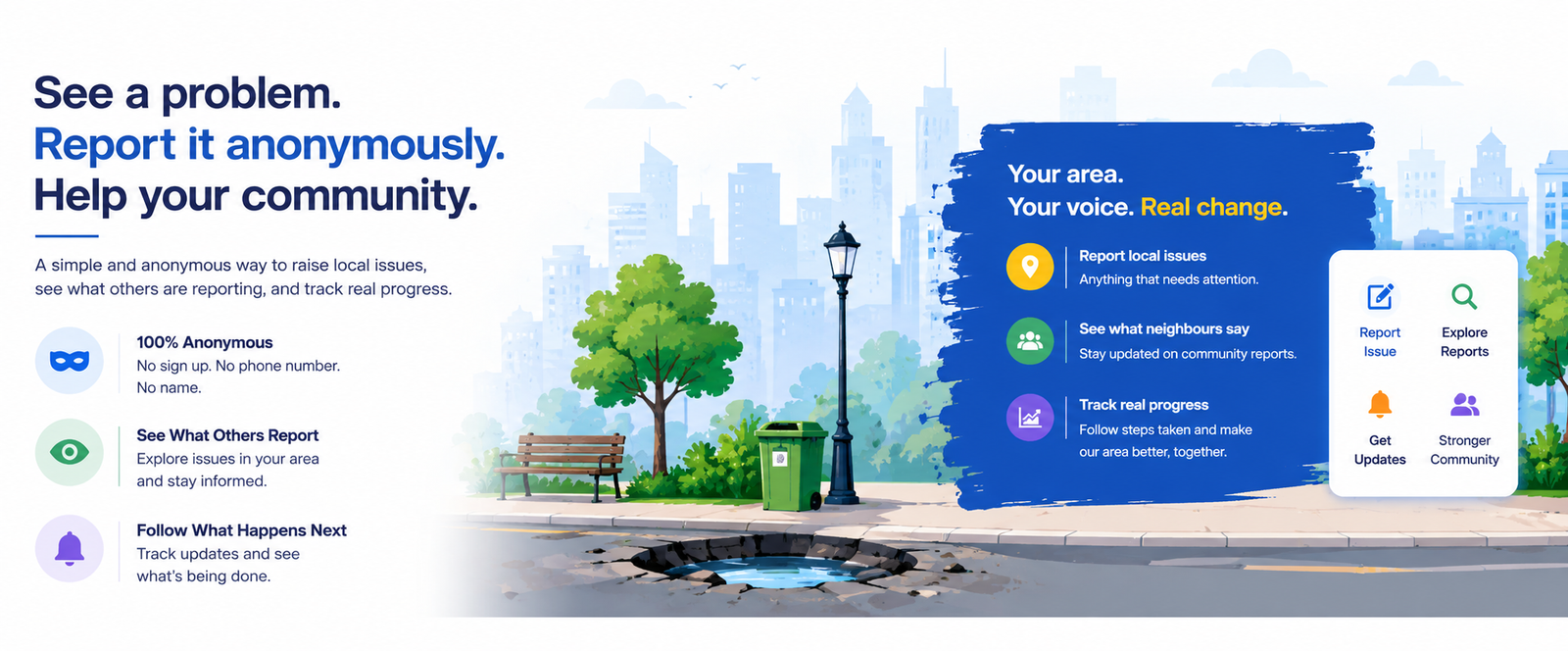
Raise a local problem. Without revealing your Identity.
A citizen platform for reporting problems where you live, seeing what neighbours have already reported, and following what happens next. No account, no phone number, no name.
Nothing you send carries your name, and photographs are cleaned of the data your camera puts in them.
27reports published
0marked resolved
17taluks covered
6languages
How it works today
Four steps, and each of them is already running. We describe what the platform actually does, not what is planned.
- 1
You report it
Describe the problem, choose the area, and add a photograph if you have one. It takes a minute and asks nothing about you.
- 2
A moderator reads it
Every report is read by a person before it appears. If it is not published you are told why.
- 3
It goes on the public board
Neighbours can see it, support it and post practical solutions underneath.
- 4
You follow it with your code
You are given a reference and an access code. Together they show you the status of your own report, whenever you want.
- 5
It reaches the right office
Once a month the problems still unresolved in your area are emailed to the District Commissioner, the Tahsildar and your MLA or MP, with the location and a link to the report.
Being sent is not the same as being acted on. This platform has no authority over any office and cannot compel a reply — what it can do is make sure the problem is on record, in public, and in front of the people whose job it is.
What we protect, and how
The reason to be careful is simple. A photograph of a problem outside somebody's house can identify who complained.
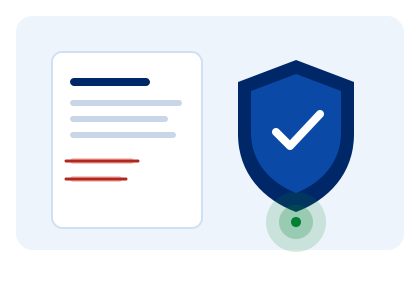
Reporting asks no name
No account, no phone number, no email to report a problem. Reports appear under a throwaway alias. Volunteers do give their name, and that is public - reporters never have to.
The position is blurred
Moderators see the exact spot. The public sees it rounded to about 500 m — the neighbourhood, not the doorway.
Photographs are cleaned
GPS, camera model, serial number and timestamps are removed from every picture before it is published.
Only you can open your report
The reference alone shows nothing. It needs the access code you were given.
What you can report
Anything that belongs to the public and is not working as it should.
Agriculture
Drainage and sanitation
Education
Electricity
Health
Other
Public safety
Roads and transport
Street lighting
Waste collection
Water supply
Recently published
See every reportPolitically neutral, and staying that way
The same rules apply to every report, whoever it concerns. The platform does not campaign for any party, and no report is promoted or buried for political reasons.
Put your name to your area
Reporting is anonymous, and that is the point. But some problems need somebody to walk down the lane and say, in their own name, that this is real. That is what a volunteer does.
- Go and look. Confirm a reported problem is there, or say plainly that it is not.
- Say when something has been put right, so it stops being counted as outstanding.
- Write about your area for the blog, read by a moderator before it appears.
- Carry a membership badge anybody can check, with your own number.
Volunteers see exactly what any visitor sees. No reporter identities, no exact locations. A badge grants access to nobody's details, because none are held.
Volunteer member
Your name here
Nanjangud taluk
VB-2026-0001
Verified membership, checkable by anyone
For departments, institutions and partners
Reports arrive already sorted by place and category, with photographs, coordinates and a timestamp. That is useful whether you are fixing the problem, funding the work, or studying the pattern.
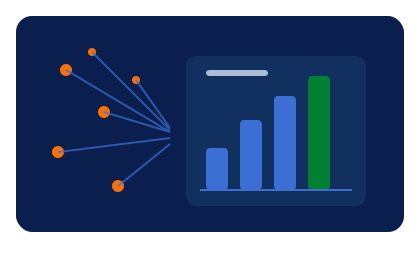
Structured local evidence
Every report carries its district, taluk, village, category and, where the reporter agreed, a verified position and time.
Aggregated, never personal
We do not hold names or numbers, so there is nothing personal to share. Only patterns.
Open to working together
Departmental routing, follow-up and district reporting are the next things being built. Early partners shape them.
Talk to us
support@voiceofbharath.com